A Look at ExecutiveOfficeGroup.com – Owned Platform
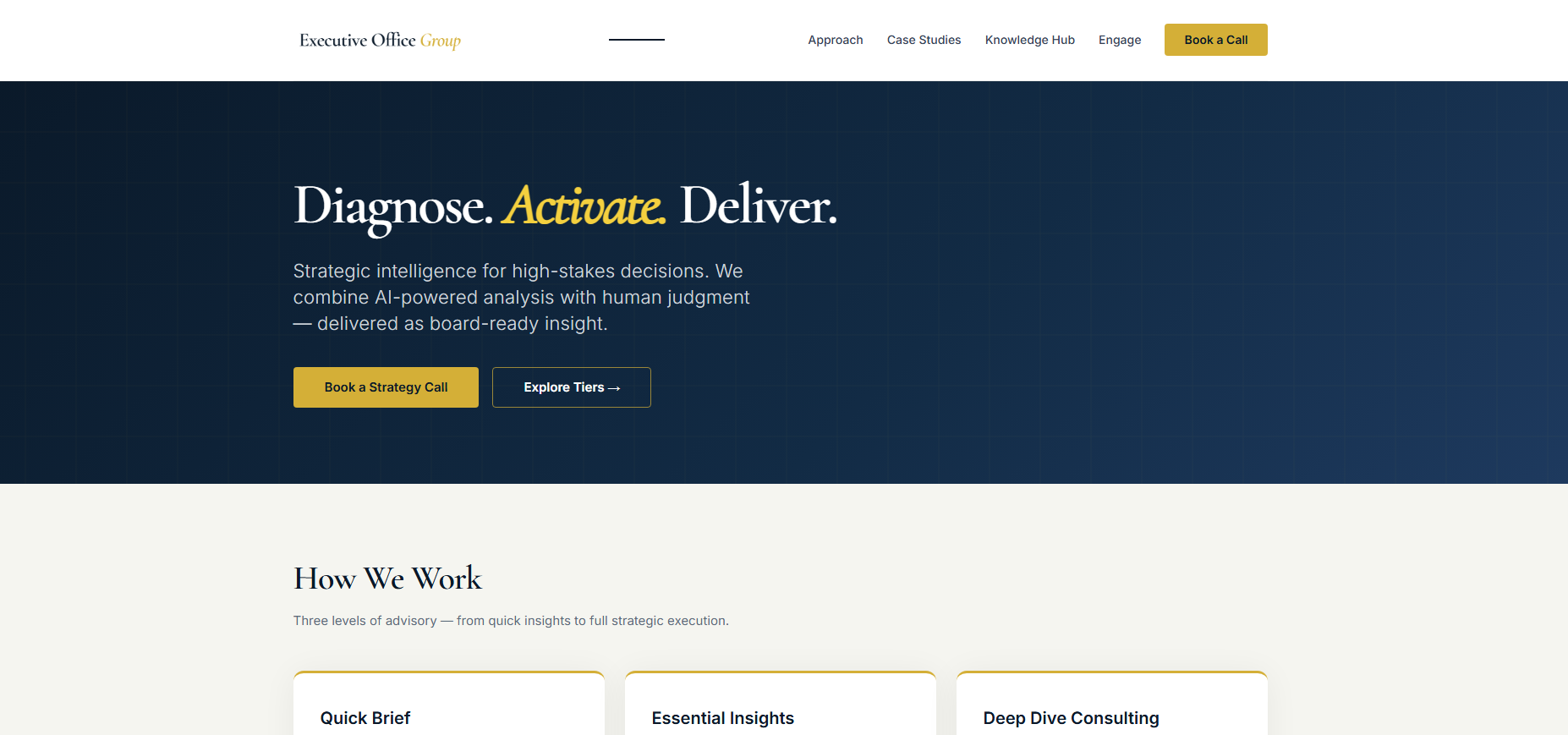
Most of what AvW Consulting publishes about owned platforms is written from the client’s side of the table. This one is written from mine, because I build and run these myself.
Executive Office Group is the most recent, and it is a useful example precisely because it is a business rather than a marketing website pretending to be one. It runs on the same architecture I would recommend to any client: an owned property, a defined offer, a content engine that earns its own traffic, and a conversion path that attributes each enquiry back to the page that produced it.
What Executive Office Group is
Executive Office Group is the trading name of AvW Consulting s.r.o. — a second brand rather than a second company. It sells strategic advisory: AI-assisted analysis combined with human judgement, packaged as board-ready insight.
It is deliberately structured in three tiers, because the alternative — an open-ended retainer whose value only becomes visible after months — is the model the rest of this site argues against:
- A standing brief. A monthly subscription for a defined number of strategic briefs, a quarterly advisory session, and access to an intelligence library.
- A single insight. A targeted deliverable — market sizing, pitch review, competitive analysis or a decision memo — produced to a fixed turnaround measured in days, not weeks.
- A full project. End-to-end strategic execution, with executive review sessions and a board-ready presentation.
Each tier is a product a buyer can self-select. The scope is stated, the output is defined, and the decision does not require a discovery call to understand what is being bought.
Why it is an example of the owned-platform model
Three things make it more than a side project.
The asset is owned. The domain, the content, the enquiry history and the client relationships belong to the business. Nothing of value sits inside a third-party marketplace that sets the terms and can change them. The same principle applies to any owned platform: if the acquisition relationship is rented, the asset is not yours.
The content is the channel. The Knowledge Hub publishes practical guides on proposals, bids and RFP response — the material a bid or proposal team is actually searching for. It is not a blog kept alive to look busy. It is the acquisition engine: publish, rank, earn the visit, convert, route the enquiry. That is the same four-step sequence every paid-lead platform performs, except here the compounding accrues to the property rather than the vendor.
The offer is productised. A service business becomes an owned platform when its delivery is packaged into something a buyer can recognise and choose, without a bespoke proposal for every enquiry. Tiering is not a pricing gimmick; it decides which enquiries are worth having and which should self-select away before they consume time.
What it illustrates about the method
Most of the decisions that shaped Executive Office Group are the same decisions that shape a client build:
- Positioning before pages. The offer, the buyer and the reason the property exists were settled before a template was built.
- Content architecture, not content volume. The hub is organised by pillar and playbook so pages reinforce one another rather than compete.
- A conversion path designed from the start. The enquiry form qualifies by role, organisation size and urgency, so the first conversation is already useful.
- Compliance as a design input. The case studies are explicitly illustrative — no client is named and no result is asserted because none has been published with permission. That honesty is a feature of the positioning, not a disclaimer bolted on.
- Measurement built in. Enquiries are attributed to their source page, so the property can be judged on the commercial value it creates rather than on traffic alone.
What carries over to a client engagement
The lesson for a client is not that every business should launch a second brand. It is that the same four questions decide whether an acquisition channel becomes an asset:
- Who owns the domain, the content and the enquiry history?
- Is there a reason for the property to exist that a competitor cannot copy in a weekend?
- Does the content earn its own discovery, or is it paid for every month?
- Is the conversion path measured against outcomes, or against activity?
Answer those well and the property compounds. Answer them badly and it is a rented channel with extra steps.
An honest note on where it is
Executive Office Group is early. I am not going to dress it up as a proven case study, because the material would not exist and the numbers would not be evidenceable. What it is, today, is a live example of the method running on its own terms: a real offer, a real content engine, a real conversion path, and a real owner carrying the second-year operating cost rather than advising someone else to.
That is the same standard applied to the owned nursing-home information platforms, which run the identical architecture in a different vertical. If you are considering an owned acquisition property, the lead-generation platforms service describes how the build works, and the contact form is the shortest way to start.